

Reflections from Cornell Tech’s Health Tech Summit: Where Health AI Meets Real-World Innovation
By Ritu M. Uberoy
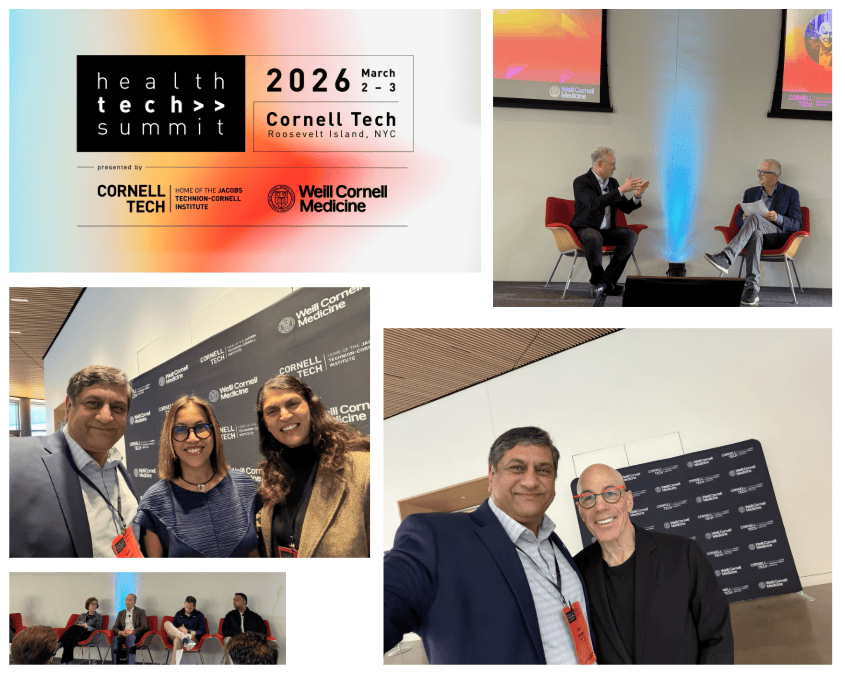
Last week, Rohit Mahajan and I had the pleasure of attending the Health Tech Summit at Cornell Tech in New York. It was an energizing gathering of founders, clinicians, researchers, investors, and healthcare leaders, all focused on one central question: How do we responsibly and effectively deploy AI in healthcare?
A special thank you to Chethan Sarabu, Director of Clinical Innovation at the Health Tech Hub, for the invitation and for bringing together such a thoughtful community of innovators.
Events like this remind me why the health tech ecosystem in New York continues to thrive—it’s where deep research, startup energy, and healthcare delivery realities come together in one room.
Health AI Is Moving From Promise to Practice
The conversations throughout the summit reflected a clear shift. We are no longer talking about whether AI will transform healthcare, but how quickly and responsibly we can deploy it at scale.
The summit—now in its fourth year—brings together stakeholders across academia, industry, and government to explore how technology can improve clinical outcomes, reduce clinician burden, and enhance the patient experience.
Several themes resonated strongly with me.
First, human-centered AI remains essential. The most promising solutions are not just technically impressive—they are designed around clinical workflows, patient experiences, and real-world healthcare constraints.
Second, collaboration across sectors is becoming the norm rather than the exception. The conversations involved health systems, startups, policymakers, and venture investors working together to build solutions that actually scale.
And third, there is growing recognition that AI innovation requires responsible implementation—balancing speed with safety, and innovation with clinical validation.
A Convergence of Research, Startups, and Industry
What makes the Cornell Tech ecosystem particularly compelling is its interdisciplinary approach. The Health Tech Hub at Cornell Tech sits at the intersection of research, entrepreneurship, and healthcare delivery, bringing together expertise from engineering, clinical medicine, and data science to drive innovation.
That model reflects where healthcare innovation is headed.
Breakthrough ideas increasingly emerge not from a single discipline but from collaboration across clinicians, technologists, and entrepreneurs. This convergence was visible throughout the summit—from academic research discussions to startup presentations and investor panels.
For founders building in healthcare AI, events like this provide something incredibly valuable: direct dialogue with the people who will ultimately use, evaluate, and deploy these technologies.
What This Means for the Future of Healthcare AI
At BigRio, we work closely with healthcare and life sciences organizations navigating the transition from experimentation to operational AI.
The themes at Cornell Tech echoed what we see every day inthe market:
- Health systems moving from pilots to enterprise-scale AI deployment
- Growing interest in AI agents and automation to reduce administrative burden
- Increasing focus on clinical safety, governance, and trust in AI systems
Healthcare organizations are realizing that the challenge is not just building AI models—it’s integrating them into complex clinical and operational environments.
That’s where collaboration between startups, health systems, and technology partners becomes critical.
The Energy of the Health Tech Community
Beyond the panels and presentations, what stood out most was the energy of the community.
Healthcare innovation is hard. It requires patience, rigor, and persistence. But events like this reinforce how many talented people are working toward the same goal: building a healthcare system that is more accessible, efficient, and patient-centered.
It was inspiring to meet founders tackling complex clinical problems, investors supporting bold ideas, and clinicians eager to shape the future of AI in medicine.
My thanks again to the Cornell Tech team and the organizers of the Health Tech Summit for bringing together such a thoughtful and impactful event.
I’m excited to continue these conversations—and to see the innovations that emerge from this vibrant ecosystem.

